
Can I Use Silicone to Seal Ductwork?
When choose duct sealant, there always has a question, what kind of sealant is best for ductwork, most common sealant include silicone sealant, latex based duct sealant and other sealants and adhesives.
Here is the comperasion between silicone sealant and duct mastic sealant.
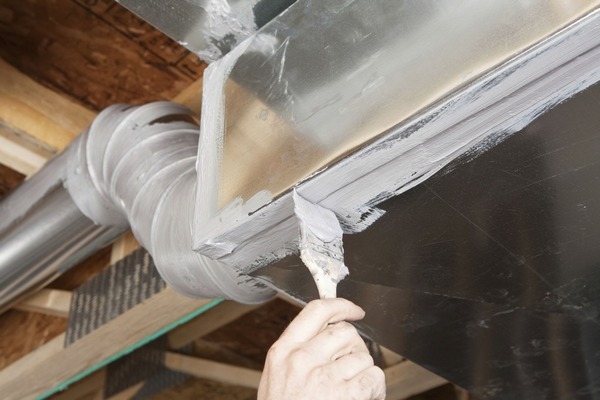
1. Silicone’s Role: The Structural Building Interface
Silicone is not a mechanical sealant for the distribution system; rather, it is a structural sealant for the building envelope interface. Its utility in HVAC is strictly limited to the transition where the mechanical system meets the stationary building structure.
Appropriate vs. Inappropriate Applications
According to the Building America Solution Center, silicone’s role is defined by material compatibility and expansion:
* Appropriate Application: Sealing the “boot-to-finish” connection (where the metal register boot meets the floor, ceiling, or gypsum wall). Building science dictates silicone here because it accommodates the differential expansion and contraction between the metallic duct and the wood or masonry structure more effectively than brittle mastics.
* Inappropriate Application: Sealing plenum connections, air-handler cabinets, or longitudinal duct seams. These mechanical junctions require the pressure-rated performance of mastics or tapes.
Beyond code compliance, there is a VOC (Volatile Organic Compound) and Indoor Air Quality (IAQ) concern. Applying RTV silicone inside the pressurized airstream often leads to persistent off-gassing. In a pressurized environment, these odors are distributed throughout the occupied space, creating long-term IAQ compliance issues and occupant dissatisfaction.
2. Professional Grade Alternatives: duct mastic
Modern HVAC engineering favors engineered seals over “patching.” High-performance mastics systems represent the current professional standard.
High-Performance Water-Based duct mastic.
Products such as STC770 duct sealant provide an engineered barrier with specific performance metrics:
* Pressure Rating: Capable of maintaining seal integrity in systems exceeding 12″ w.g. (water gauge).
* Environmental Resilience: Formulated with mold and mildew inhibitors for both conditioned and unconditioned space applications.
* Low VOC Emissions: Meets California Department of Public Health emission requirements, contributing to LEED EQ credits.
3. Conclusion: Compliance and Performance
Effective duct sealing is an investment in the building’s life-cycle performance. Using non-labeled silicone on a plenum or failing to seal a return duct represents a violation of fundamental building science and professional codes.
The Verdict: Silicone is for the building-to-boot transition; duct sealant is for the ducts themselves.
Expert Tip: To ensure an engineered bond, all surfaces must be clean, dry, and free of oil or legacy adhesives. Furthermore, compliance with the 72-hour rule is mandatory: the sealant must be protected from rain and water exposure for at least 72 hours to reach full cure. Prior to pressure testing, allow a 24- to 72-hour dry time, adjusted for local temperature and humidity levels.