
What Is the Coverage of 1 Gallon of Duct Mastic?
When you stand in the hardware store aisle staring at those big buckets of grey goo, one major question pops up: What is the coverage of 1 gallon of duct mastic?
Do you need one gallon? Two? Five?
No one wants to run out of mastic halfway through a messy job, nor do you want a 4-gallon leftover bucket gathering dust in your garage for the next ten years.
Let’s break down the exact math, real-world variables, and how to estimate exactly how much you need for your home.
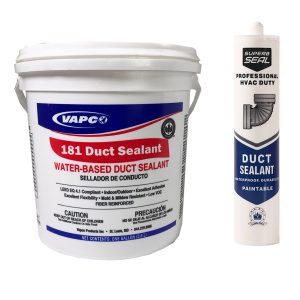
The Short Answer: The 1-Gallon Rule of Thumb
If you ask the shopper, they will tell you that under perfect conditions:
1 gallon of water-based duct mastic covers approximately 25 to 50 square feet.
Now, we know what you are thinking: “25 to 50 square feet is a huge range! Why the gap?”
That’s because mastic coverage depends entirely on how thick you apply it. To meet standard building codes, duct mastic needs to be applied about 32 mils thick—which is roughly the thickness of a nickel or a credit card.
If you paint it on paper-thin like regular wall paint, it won’t seal properly. If you slop it on like cake frosting, your coverage will drop closer to that 25 sq. ft. mark.
Translating “Square Feet” to Real-World HVAC Joints
Since you aren’t coating flat walls, measuring in square feet can be confusing. Let’s translate that into something you can actually count: Duct Joints.
Standard Round Ducts (6-inch to 8-inch residential lines): 1 gallon will typically seal between 80 and 100 joints if you are painting a 2-inch wide band around each connection.
Large Rectangular Plenums/Trunks: Because these have much larger perimeters, 1 gallon usually covers about 20 to 30 major connections.
3 Things That “Steal” Your Mastic Coverage
Not all duct sealing jobs are created equal. Here are three hidden factors that will change how far your gallon goes:
1. Are You Using Fiberglass Mesh Tape?
If you have gaps in your ductwork wider than 1/4 inch, you cannot just slap mastic over them—it will sag and crack. You need to use fiberglass mesh tape to bridge the gap, acting like rebar in concrete.
The Mastic Cost: Mesh tape absorbs a lot of mastic. If you are reinforcing all your joints with mesh, expect your coverage to drop by about 15% to 20%.
2. Flexible Ducts vs. Sheet Metal
Metal ducts are smooth and predictable. Flex ducts, however, have those annoying ridges and plastic inner linings. Navigating the ridges of a flex duct connector requires a bit more “dollop” on your brush, which eats up more material.
3. Your Application Tool
Paintbrush/Mastic Brush: Grabs a lot of material and lays it down thick. Great for quality, but heavier on usage.
Gloved Hand: Believe it or not, many pros just put on a heavy-duty nitrile glove and smear it by hand. It’s fast, highly accurate, and leads to less wasted mastic left behind in brush bristles.
Quick Cheat Sheet: How Much Mastic Do I Need?
| Project Size | Typical Duct Setup | Recommended Amount |
| Small Repair / One Room | Sealing 5-10 register boots | 1 Quart (0.25 Gallon) |
| Average Townhouse / Apartment | Simple layout, accessible lines | 1 Gallon |
| Standard Home (1,500 – 2,500 sq ft) | Full attic or crawlspace duct system | 1 to 2 Gallons |
| Large Home / Total Duct Replacement | Multiple zones, complex rectangular trunks | 2 to 3 Gallons |
Pro-Tips for Getting the Most Out of Your Gallon
Before you crack open that bucket, keep these veteran tips in mind:
Clean the Metal First: Mastic hates dust and construction grease. Wipe down the ducts with a damp rag first. If the mastic can’t stick, it wastes your time and material.
Watch the Weather: Most popular mastics are water-based. If you are working in an unconditioned attic that is freezing cold or insanely humid, the curing (drying) time will double, and the material can become harder to spread smoothly. Aim for a day when it’s above 40°F (4°C).
Keep it Airtight: If you buy a 1-gallon bucket and only use half, hammer the lid back on tight! Put a layer of plastic wrap directly on top of the leftover mastic surface before sealing the lid to keep it from skinning over.
The Bottom Line
For the vast majority of homeowners tackling a weekend DIY energy-efficiency project, a single 1-gallon bucket of duct mastic is more than enough to seal up the leaking joints of an average family home.
Ready to get started on your home comfort upgrade? Browse our professional-grade, low-VOC [Duct Mastic and Sealing Accessories here], or leave a comment below if you have a tricky duct angle you aren’t sure how to measure!