
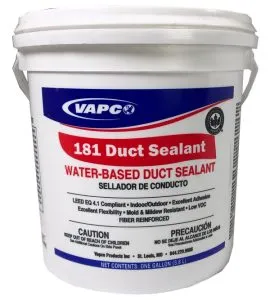
what is mastic duct sealant ?
Mastic duct sealant is a sealing material that uses water-based acrylic or latex as a dispersion medium. Compared with traditional oil-based or solvent-based sealants, it has significant advantages in environmental friendliness and safety.
🌱 Key Features
Environmentally Friendly and Safe: Contains no or only a small amount of volatile organic compounds (VOCs), resulting in virtually no odor during construction and use, making it more environmentally friendly and health-friendly.
Easy to Apply: Tools can usually be washed directly with water, and it is easy to clean if accidentally spilled before curing.
Wide Range of Applications: Suitable for sealing various building joints and pipes.
🔍 Main Types and Applications:
Based on different functions and ingredients, Mastic duct sealant are mainly divided into the following categories:
General-Purpose mastic duct Sealants: These sealants are mainly used for conventional bonding and sealing and do not have special fireproof or waterproof functions.
Typical Applications: Commonly used for sealing metal duct seams,Covering connections around vents and plenums,repairing small leaks in rigid fiberglass ducts and Improving HVAC efficiency and airflow.
Water-based Fire-retardant Sealant
This is a functional sealant that, in addition to its basic sealing function, possesses excellent fire-retardant properties.
Core Function: In the event of a fire, the sealant expands when heated, forming a dense charred layer that effectively blocks the spread of flames, smoke, and toxic gases.
Typical Applications: Specifically designed for sealing gaps created by various pipes (such as metal and plastic pipes) penetrating walls and floors, cable trays, etc., making it an important passive fire-resistant material.
Precautions
When selecting and using mastic duct sealants, please note the following:
Curing Time: The surface drying and complete drying times of duct sealants are greatly affected by ambient temperature and humidity. Application is not recommended at low temperatures (e.g., below 10℃) or excessively high humidity.
Water Resistance: Some water-based sealants may dissolve or have their performance affected by water contact before complete curing (usually before surface drying). Always ensure the product is fully cured before contact with water.
Substrate Compatibility: Before use, please confirm that the sealant is suitable for the pipe material you are dealing with (e.g., PVC, metal, etc.).