
How do I know if my ducts are leaking?
In commercial facilities, warehouses, and large-scale residential projects, the HVAC system is one of the highest operational expenses. However, poorly sealed or deteriorating ductwork joints routinely cause a staggering 20% to 30% loss of conditioned air.
For facility managers, MEP (Mechanical, Electrical, and Plumbing) contractors, and property owners, a leaking duct is not just a comfort issue—it is a direct hit to your bottom line, resulting in inflated energy bills, premature equipment wear, and indoor air quality (IAQ) liabilities.
Detecting these leaks early requires looking beyond the obvious. Here is how professional operators diagnose duct leakage before it escalates into a systemic failure.
1. The Unexplained Surge in Utility Costs
If your production schedule or occupancy rates have remained constant, but your monthly energy consumption shows a steady upward trajectory, your HVAC units are likely working overtime. When heated or cooled air escapes into unconditioned spaces (like drop ceilings or service shafts), the system must run longer cycles to meet the thermostat settings.
2. Uneven Static Pressure and Airflow Discrepancies
In a well-designed commercial ventilation layout, airflow is a game of balanced pressure. If tenants or floor managers complain about “hot spots” or stagnant zones in specific sectors of the building, it rarely indicates a faulty chiller or furnace. Instead, it typically points to a localized pressure drop caused by broken seams, failed tapes, or cracked mastic sealants along the branch runs.
3. Excessive Dust Accumulation Near Supply Registers
Leaky ducts create a Venturi effect. When the system cycles off or pressure shifts, return or supply leaks pull in ambient particulate matter, fiberglass insulation fibers, and dust from structural voids. If you notice a dark ash-like residue or heavy dust tracking around supply diffusers, the internal integrity of your duct runs has been compromised.
4. Auditory Clues: Whistling and Rattling
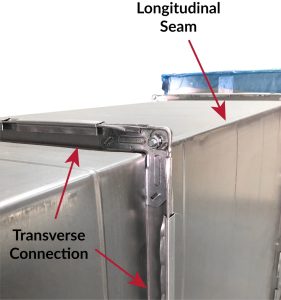
High-velocity commercial HVAC networks operate under significant static pressure. When air is forced through a loose flange, a degraded gasket, or a longitudinal seam separation, it creates distinct acoustic feedback. Whistling, hissing, or structural rattling during startup cycles are clear mechanical indicators of structural gaps.
5.Technical Diagnostic Methods for Professionals
If you suspect leaks based on the signs above, visual inspection is rarely enough, especially in concealed installations. Professional MEP teams rely on the following quantitative tests:
Diagnostic Method | How It Works | Best For |
Duct Blaster Test | Fans pressurize the duct system to a specific Pascal level (e.g., 25 Pa) to measure the exact CFM (Cubic Feet per Minute) air loss. | Compliance certification & benchmarking. |
Thermal Imaging (IR) | Infrared cameras scan wrapped or exposed ductwork while running heat or AC to reveal immediate “hot/cold plumes” escaping from joints. | Rapid troubleshooting without shutting down facilities. |
Static Pressure Testing | Comparing supply-side plenum pressure against design specifications to pinpoint major systemic restrictions or drop-offs. | Evaluating older commercial properties during retrofits. |
6.The Cost of Neglect vs. High-Performance Sealing
Leaving ductwork untreated does more than waste air; it introduces moisture differentials that lead to mold growth inside structural walls, potentially failing building code inspections.
For modern commercial projects, relying on standard cloth duct tape is a short-term failure strategy. Long-term HVAC integrity demands industrial-grade MS Polymer sealants, heavy-duty acrylic mastics, or specialized polyurethane foams engineered to withstand continuous thermal expansion and high static vibrations without drying or cracking.