
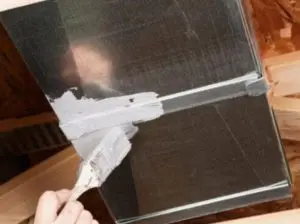
If you’ve ever walked through a commercial construction site or inspected a mechanical room, you’ve probably seen it: a thick, gray, paint-like substance smeared over the joints and seams of sheet metal ductwork.
It’s not exactly pretty, but it is one of the most critical components of a high-performing heating, ventilation, and air conditioning (HVAC) system.
It’s called HVAC mastic, and if your buildings don’t have it, you’re likely leaking money directly into your utility bills. Let’s break down exactly what this material is, why it matters for commercial properties, and why traditional tape just doesn’t cut it.
What is HVAC Mastic?
HVAC mastic is a high-velocity, flexible sealant specifically engineered to seal the joints, seams, and connections in air duct systems.
Unlike standard adhesives, mastic has a thick, paste-like consistency—similar to smooth peanut butter—when applied. It is typically brushed, troweled, or caulked on. Once cured, it forms a durable, rubbery, and completely airtight seal that can withstand the constant pressure fluctuations within an HVAC system.
Water-Based vs. Solvent-Based Mastic
While there are a few types on the market, the commercial industry heavily favors water-based acrylic mastic. It’s easy to clean up, emits low volatile organic compounds (VOCs), and safely meets strict commercial building and fire codes (like UL 181A-M or UL 181B-M certifications).
The “Duct Tape” Myth: Why Tapes Fail
In a B2B environment—whether you are a property manager, general contractor, or facility engineer—longevity is everything. One of the most common mistakes in building maintenance is relying on traditional duct tape to seal ductwork.
Despite its name, standard duct tape is actually terrible for HVAC ducts.
| Feature | HVAC Mastic | Traditional Duct Tape |
| Longevity | Lasts 20+ years (often outlives the system) | Dries out and fails within 2–5 years |
| Flexibility | Expands/contracts with temperature changes | Becomes brittle and cracks |
| Adhesion | Bonds permanently to sheet metal and fiberboard | Adhesive breaks down due to heat and dust |
| Compliance | Meets strict UL 181 standards for commercial builds | Rarely meets modern commercial building codes |
While specialized foil tapes (like butyl or mastic tape) have their place for quick fixes or tight spaces, liquid mastic remains the gold standard for a permanent, impenetrable seal.
Why Mastic is Non-Negotiable for Commercial Buildings
According to data from the U.S. Department of Energy, the average commercial building leaks roughly 10% to 30% of its conditioned air through poorly sealed ducts. In a large-scale facility, that translates to thousands of dollars wasted every single month.
Here is how investing in proper mastic sealing impacts a business’s bottom line:
1. Drastic Energy Savings
When air leaks out of ducts before reaching its destination, your RTUs (Roof Top Units) and chillers have to work twice as hard to maintain the thermostat setpoint. Mastic ensures that 100% of the air you paid to heat or cool actually reaches the occupied spaces, slashing operational energy costs.
2. Improved Indoor Air Quality (IAQ)
Ductwork doesn’t just leak air out; unsealed return ducts can pull dirty air in from drop ceilings, crawl spaces, and mechanical rooms. This introduces dust, mold spores, and pollutants into the breathing zone. Properly applied mastic creates a barrier that protects building occupants and keeps indoor air clean.
3. Code Compliance and LEED Certification
Modern commercial building codes (such as IECC and ASHRAE 90.1) enforce strict duct-leakage testing. Furthermore, if you are aiming for LEED certification or trying to meet strict ESG (Environmental, Social, and Governance) targets, sealing your distribution system with low-VOC mastic is an easy, measurable win.
Pro Tip for Application: For gaps wider than 1/8 of an inch, mastic should always be paired with a fiberglass mesh tape. The mesh acts like rebar in concrete, giving the liquid mastic structural integrity to bridge larger gaps without cracking as the ducts expand and contract.
The Bottom Line
HVAC mastic might not be the most glamorous part of a commercial build, but it is the literal glue holding your building’s efficiency together. Securing a tight envelope on your ductwork protects mechanical equipment from premature wear, keeps tenants comfortable, and keeps utility costs predictable.
If you are auditing an existing facility or overseeing a new mechanical installation, make sure your contractors aren’t cutting corners with cheap tapes. Insist on a fully sealed system utilizing high-quality, UL-certified HVAC mastic.