
What Is the Best Secondary Sealant for Insulating Glass?
Why the Secondary Seal Matters in an IG Unit
Every insulating glass unit relies on two seals working together. The primary seal keeps moisture vapour out and the desiccant dry. The secondary seal takes the structural load and locks the unit against the elements. Picking the best secondary sealant for insulating glass decides whether the IGU passes EN 1279 or fails within five years. For most commercial and high-rise projects, two-component silicone leads the field.
What the Secondary Seal Does
The secondary seal bonds the glass panes to the spacer bar at the edge of the IGU. It holds the unit together under wind load, resists water ingress, and retains any insulating gas such as argon. It also bonds the IGU to the structural frame in unitized curtain wall systems. A weak secondary seal causes spacer migration, gas leakage, and visible condensation between the panes. That is why the secondary seal matters more than the primary for long-term performance.
Why Two-Component Silicone Leads
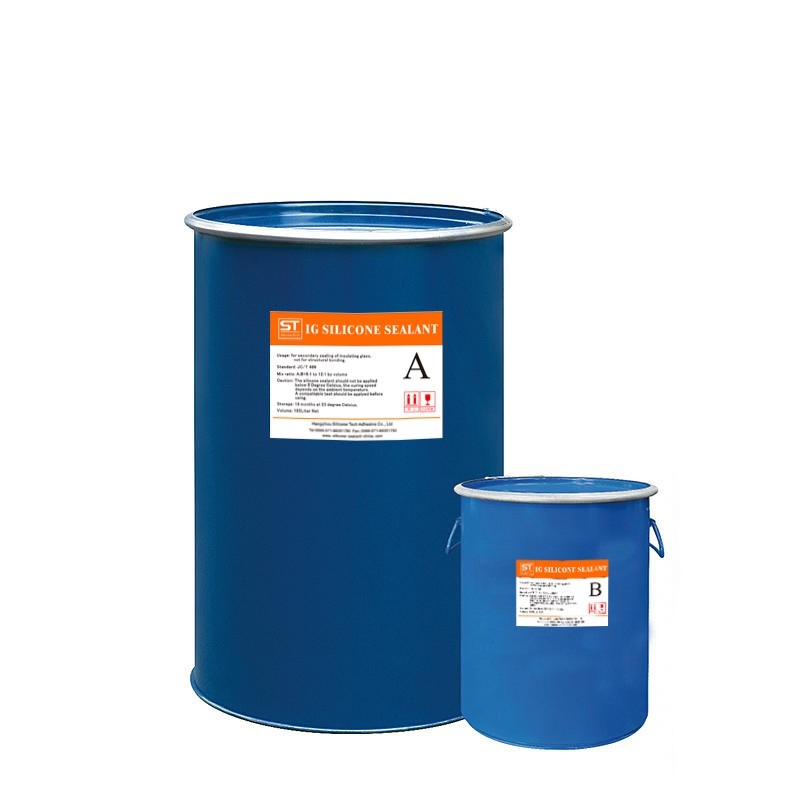
Two-component silicone cures by chemical reaction, not by solvent evaporation. This gives the material uniform mechanical properties across the full depth of the joint. It also gives silicone a service temperature range of -50°C to 150°C without losing bond strength. UV exposure does not degrade the polymer, so the unit survives decades of sunlight at the edge seal. For IGU production, a product such as the double glazing sealant formulated with 2K A and B components delivers tensile strength. The cured material tests at 0.8 to 1.2 MPa. That is well above the 0.5 MPa threshold EN 1279 specifies for structural use.
Comparing Polysulfide, Polyurethane, and Silicone
Polysulfide used to dominate IG secondary seals. It still has a place in residential and standard commercial units. It bonds well to aluminium and glass, has good gas retention, and remains flexible across temperature swings. The drawback is slow UV degradation. Polyurethane cures strong bonds but tolerates little moisture during cure. Most IGU fabricators have moved away from it. Silicone beats both on UV resistance, gas retention, and processing speed. For high-rise façades, structural glazing, and hurricane-grade units, silicone is the default. For residential sealed units with shorter service life, polysulfide still holds its place.
When to Choose a Hybrid System
Some IGU designs call for both a PIB primary seal and a structural silicone secondary. PIB (polyisobutylene) has the lowest moisture vapour transmission of any sealant on the market. Combining PIB primary with two-component silicone secondary gives the lowest possible gas and moisture loss rates. This is the spec used in passive house windows and high-performance curtain wall. The extra material cost returns value through 30-year service life and zero edge-seal failure.
Bottom Line
The best secondary sealant for insulating glass in most commercial projects is two-component silicone. It beats polysulfide on UV resistance and polyurethane on processing tolerance. For residential work, polysulfide remains acceptable. For maximum service life, pair a PIB primary with a silicone secondary. Match the sealant to the unit spec, not the lowest bid. The IGU will then deliver its rated performance for decades.